2026-06-03
The Correct Way to Take Antibiotics
Learn how to use antibiotics safely and effectively to prevent antibiotic resistance, following the latest guidelines from the Korea Disease Control and Prevention Agency (KDCA).
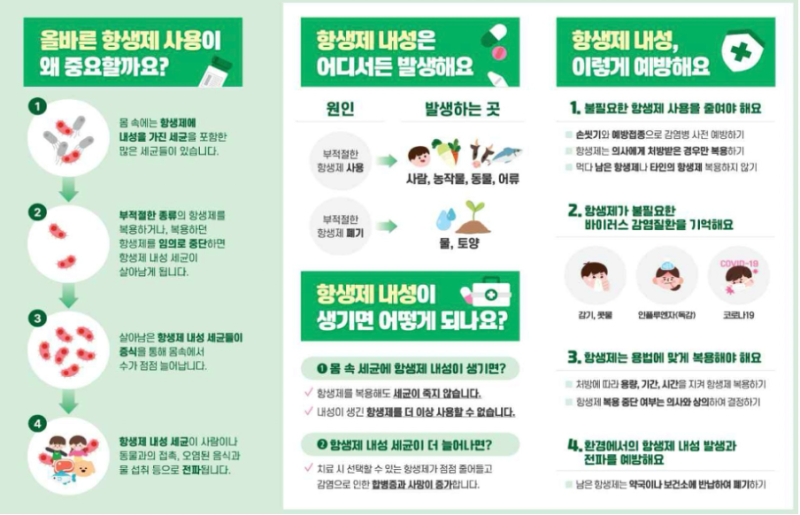
Antibiotics are a major medical achievement that has significantly extended human lifespan by treating bacterial infections. However, the Korea Disease Control and Prevention Agency (KDCA) has recently warned that ‘antibiotic resistance’ caused by the misuse and overuse of antibiotics is a serious public health threat. Antibiotic resistance reduces the effectiveness of medicine and becomes a major obstacle in treating severe infections, requiring special attention. In this article, we will look at safe and effective ways to take antibiotics according to recent KDCA recommendations.
What are antibiotics? Why should they only be used when absolutely necessary?

Antibiotics are drugs that kill bacteria or inhibit their growth. Bacteria are microorganisms that live and reproduce on their own, multiplying by building cell walls and synthesizing proteins. Antibiotics selectively block specific parts of these life-sustaining processes in bacteria. For example, they may weaken the bacterial wall to make it burst or prevent protein synthesis so the bacteria can no longer multiply. Therefore, they are effective against bacterial pneumonia, bacterial tonsillitis, and some types of bacterial enteritis. However, they are ineffective against diseases caused by viruses, such as the common cold or the flu. This is because viruses have a different structure than bacteria and multiply inside our body’s cells, making them unreachable by antibiotics that target bacteria.
Principles of Antibiotic Use | |
Target Use | Bacterial infections (bacterial pneumonia, bacterial tonsillitis, some bacterial enteritis, etc.) |
Unnecessary Use | Viral diseases such as colds, flu, and most acute rhinitis |
Prescription Criteria | Comprehensive judgment based on symptoms + clinical findings + test results if necessary |
How to Take | Adhere to the prescribed dosage, interval, and duration |
Stopping Medication | Do not stop arbitrarily even if symptoms improve |
Most Important Principle | ‘Only when necessary, accurately, and until the end’ |
Using antibiotics for the wrong cause not only fails to improve treatment effectiveness but also increases unnecessary drug exposure and the risk of side effects. Common side effects include gastrointestinal symptoms such as abdominal pain, diarrhea, and stomach discomfort, which occur because beneficial gut bacteria are also affected. In rare cases, allergic reactions like skin rashes or hives may occur, and certain antibiotics can affect liver or kidney function, so they must be used carefully under medical supervision. This leads to the question: ‘Why can’t I stop taking antibiotics midway if my symptoms have improved?’ When you take antibiotics, the bacteria that are weak against the drug die off quickly first. This is often when symptoms improve. However, relatively stronger bacteria may still remain. If you stop taking the medication, the surviving bacteria may multiply again, causing a relapse, or ‘resistant bacteria’ that have adapted to the drug will selectively survive. This is the beginning of antibiotic resistance. In fact, the KDCA consistently advises that finishing the prescribed course of antibiotics is crucial for preventing resistance.
Side Effects of Antibiotics | |
Common Side Effects | Abdominal pain, diarrhea, stomach discomfort, nausea > Occurs because antibiotic use affects beneficial gut bacteria |
Allergic Reactions | Rash, hives, itching, and rarely anaphylaxis |
Organ-Specific Side Effects | Abnormal liver function, decreased kidney function, tendon inflammation in some classes |
Serious Complications | Antibiotic-associated diarrhea, Clostridioides difficile infection |
The Biggest Problem | Development of antibiotic resistance (emergence of bacteria that do not respond to drugs) |
It is important to use antibiotics ‘accurately’—in the right situation, at the appropriate dose, and for the recommended duration—rather than simply ‘using them a lot.’
Antibiotic Prescription Principles by Department
Recently, the KDCA, along with seven related ministries, established the ‘3rd National Antibiotic Resistance Management Plan (2026–2030)’ after deliberation by the Expert Committee on Antibiotic Resistance and the Infectious Disease Management Committee. While antibiotics are essential for treating bacterial infections, they are ineffective against viral diseases (colds, influenza, most acute rhinitis, etc.). Therefore, all medical departments prescribe them carefully according to the following principles:
Internal Medicine & Gastroenterology
Antibiotics are not prescribed for simple colds or influenza; they are used only when a clear bacterial infection such as bacterial pneumonia or enteritis is diagnosed, adhering to the appropriate dosage and duration.
Surgery & Dermatology
For the purpose of preventing infection after surgery or in the case of purulent skin diseases, the standard antibiotic most suitable for the causative bacteria is selected and prescribed first.
Family Medicine
The patient’s past antibiotic history and allergies are thoroughly checked, and customized prescriptions are issued only when necessary by synthesizing symptoms and clinical findings.
KDCA Recommended ‘3 Core Rules for Antibiotic Use’
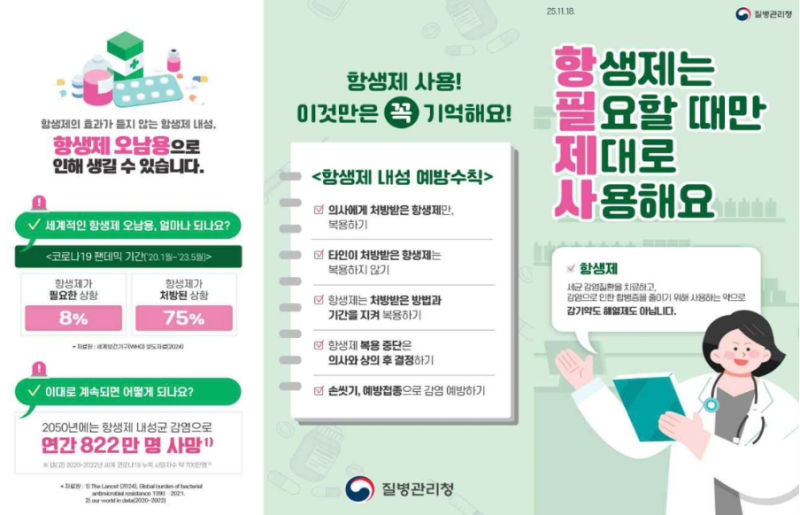
The KDCA emphasizes three core rules that patients must follow in their daily lives to prevent antibiotic resistance:
1. Follow the Doctor’s Prescription
Take antibiotics only when a professional deems it necessary, and do not take them arbitrarily for viral diseases like the common cold.
2. Strictly Observe the Duration of Use
Even if symptoms improve, you must finish the prescribed course; stopping early allows surviving bacteria to acquire resistance.
3. No Sharing of Medication
Do not take leftover antibiotics or someone else’s medication, and do not share your medicine with family or friends.
* Source for Photos 1 & 2: https://www.kdca.go.kr/kdca/2848/subview.doenc=Zm5jdDF8QEB8JTJGYmJzJTJGa2RjYSUyRjQyJTJGMjE1NDY5JTJGYXJ0Y2xWaWV3LmRvJTNG
Updated Government Guidelines and ‘Antibiotic Appropriateness Evaluation’

The government is currently systematically managing the use of antibiotics in medical institutions through the ‘2nd National Antibiotic Resistance Management Plan (2021–2025).’ Beyond simply using fewer antibiotics, the government is strengthening the ‘Antibiotic Appropriateness Evaluation’ to ensure that the most suitable antibiotic for a disease is used for the appropriate duration. By strengthening this evaluation, the government aims to simultaneously pursue patient safety and a reduction in the occurrence of resistant bacteria.
Antibiotics are a grateful presence that saves lives when used correctly, but they can become a poison that breeds ‘superbugs’ in our bodies if used incorrectly. As the KDCA emphasizes, successful antibiotic treatment depends on accurate diagnosis and prescription by medical staff and strict adherence to the regimen by patients. The small act of finishing your prescribed antibiotics is the most certain way to protect your health.
— Reference: Korea Disease Control and Prevention Agency (Strengthening National Response to Block Antibiotic Misuse and Overuse) /
https://www.kdca.go.kr/kdca/2847/subview.do?enc=Zm5jdDF8QEB8JTJGYmJzJTJGa2RjYSUyRjQxJTJGMzEwMjM3JTJGYXJ0Y2xWaWV3LmRvJTNG
Frequently Asked Questions
Can I take antibiotics if I have a cold or flu?
No, they are not effective. Antibiotics are medicines that kill or inhibit bacteria, so they do not work against colds, flu, or acute rhinitis, which are caused by viruses. They should only be taken when there is a clear diagnosis of bacterial infection, such as bacterial pneumonia or tonsillitis.
Can I stop taking antibiotics when my symptoms improve?
No, you must complete the entire prescribed course. If you arbitrarily stop taking the medication when your symptoms improve, there is a high risk that the surviving, relatively strong bacteria will multiply again, leading to a relapse, or that drug-resistant bacteria will develop.
What are the possible side effects when taking antibiotics?
The most common side effects are gastrointestinal symptoms such as abdominal pain, diarrhea, and nausea. This is because antibiotics also affect beneficial bacteria in the gut. Rarely, allergic reactions such as skin rashes or hives may occur, and they can also affect liver or kidney function.
Can I save leftover antibiotics and take them later or share them?
Absolutely not. According to the Korea Disease Control and Prevention Agency's three core principles for antibiotic use, you should not arbitrarily take leftover antibiotics or someone else's medication, nor should you share them with family or friends. You must only take them yourself, according to a doctor's diagnosis and prescription.