2026-06-20
Olive Oil Instead of Soybean Oil? Let’s Get to Know the Cooking Oils We Use Every Day
Learn why the ratio of Omega-6 to Omega-3 matters in cooking oils and how choosing the right oil, like olive or perilla oil, can improve your cardiovascular health.
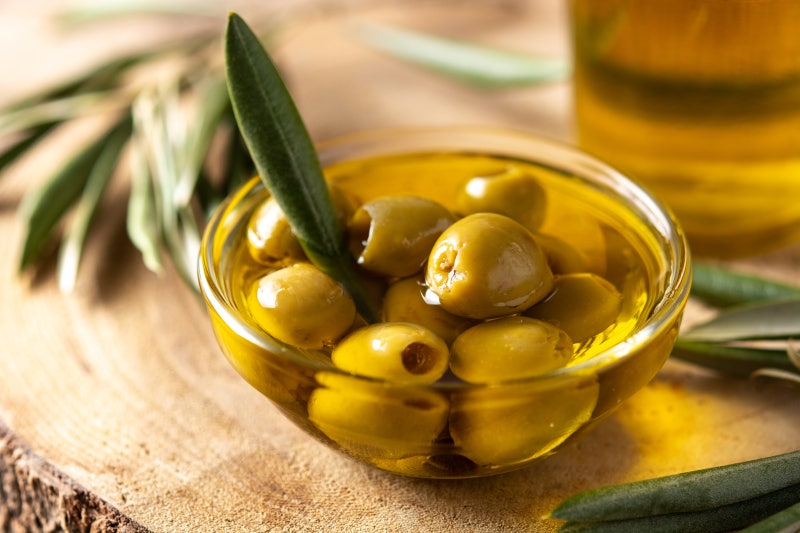
Is grapeseed oil really a healthy oil?
When you go to the supermarket, there are many cooking oils labeled as ‘healthy.’ Grapeseed oil is one of them.
Because grapes themselves are perceived as a healthy ingredient, grapeseed oil is naturally regarded as a good oil.
However, looking at the actual fatty acid composition tells a different story. Common cooking oils like grapeseed, sunflower, corn, and soybean oil share a common trait: their Omega-6 ratio exceeds 50%, while they contain almost no Omega-3. The key to choosing a cooking oil lies in this ratio of Omega-6 to Omega-3.
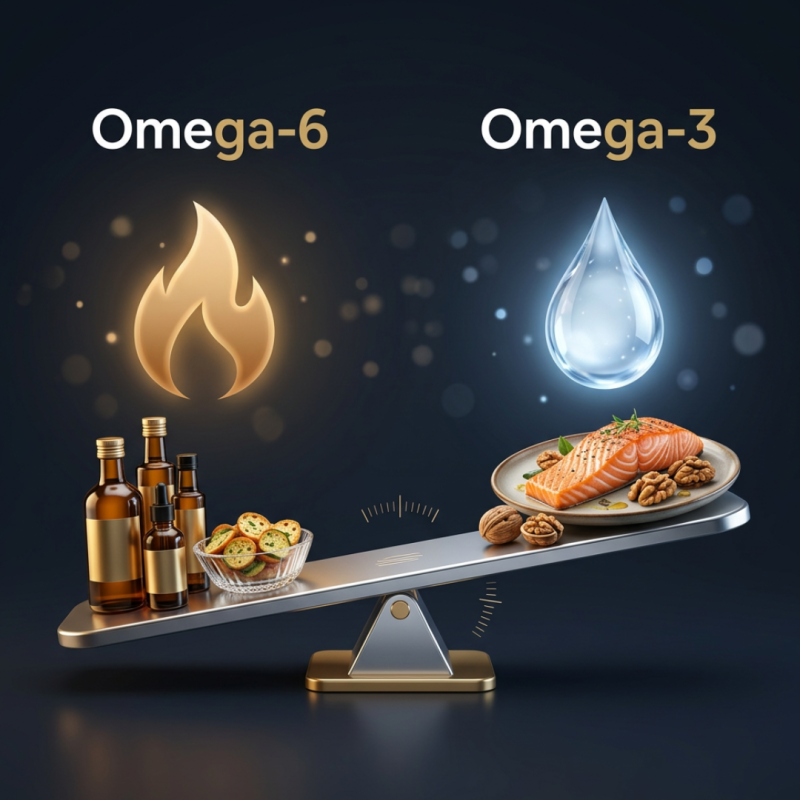
Why is the ‘ratio’ of Omega-6 to Omega-3 important?
Omega-6 and Omega-3 are both essential fatty acids our bodies need, but they perform different, sometimes opposing, functions within the body.
Omega-6 is involved in signaling that triggers inflammation, while Omega-3 plays a role in regulating and alleviating it. Since these two fatty acids compete for the same enzymes in the body, an excess of one can relatively inhibit the action of the other.
The problem is that Omega-6 intake in the modern diet is becoming overwhelmingly high. Depending on the type of cooking oil used daily, this ratio can widen drastically.
What is a healthy Omega-6 to Omega-3 ratio?
According to research, a healthy ratio of Omega-6 to Omega-3 is known to be less than 4:1. It is estimated that in primitive diets consumed by humans before grain-based agriculture, this ratio was close to 1:1.
These figures are not just theoretical. In the past ‘Lyon Diet Heart Study,’ lowering the Omega-6 to Omega-3 ratio to less than 4:1 by changing cooking oils resulted in a significant reduction in the incidence of cardiovascular complications among myocardial infarction survivors. This case demonstrates that simply changing the type of oil can make a real difference in clinical outcomes.
Comparison of Fatty Acid Profiles by Major Cooking Oils
The table below summarizes the ratios of Omega-6, Omega-3, and Omega-9 (*monounsaturated fatty acids) in cooking oils we commonly encounter.
As seen in the table, the ratio of Omega-6 to Omega-3 varies greatly depending on the type of oil. This means the fatty acid balance of your entire diet is largely determined by which oil you use as your primary choice.
Cooking Oils Rich in Omega-9
Fatty Acid Composition (%) | ||||
| Omega-3 (Alpha-Linolenic Acid) | Omega-6 (Linoleic Acid) | Omega-9 (Oleic Acid) | Saturated Fat |
Olive Oil | 0.5~1 | 8~12 | 70~75 | 10~20 |
Cooking Oils Rich in Omega-6
Fatty Acid Composition (%) | ||||
| Omega-3 (Alpha-Linolenic Acid) | Omega-6 (Linoleic Acid) | Omega-9 (Oleic Acid) | Saturated Fat |
Grapeseed Oil | ~0 | 65~75 | 12~20 | ~10 |
Sunflower Oil (Standard) | ~0 | 60~70 | 20~25 | 10~12 |
Corn Oil | <1 | 50~60 | 25~30 | ~13 |
Soybean Oil | 7~8 | 50~55 | 25~30 | 14~16 |
Cooking Oils Rich in Omega-3
Fatty Acid Composition (%) | ||||
| Omega-3 (Alpha-Linolenic Acid) | Omega-6 (Linoleic Acid) | Omega-9 (Oleic Acid) | Saturated Fat |
Perilla Oil | 55~65 | 12~20 | 10~15 | 7~10 |
*What are monounsaturated fatty acids?
Monounsaturated fatty acids (Omega-9) have only one double bond in their fatty acid structure, making them relatively stable. They do not oxidize easily while remaining liquid at room temperature.
Representative Foods
Vegetable oils: Olive oil, avocado oil, etc.
Fruits: Avocado
Nuts: Almonds, macadamia nuts, cashews
Two reasons why olive oil is considered a healthy oil
There are two clear reasons why olive oil is frequently mentioned as a health food.
First, it has a low Omega-6 ratio.
Omega-6 accounts for only about 10% of the total fatty acids in olive oil. Thanks to this, adding just a small amount of Omega-3 rich foods can easily bring the overall Omega-6 to Omega-3 ratio into a healthy range.
Second, olive oil consists of fats that do not oxidize easily.
Inside our bodies, oil can deteriorate over time when it meets oxygen. Simply put, a phenomenon similar to ‘rusting’ occurs, which is professionally called oxidation.
The problem is that this oxidation doesn’t just stop at the oil. If an oil has properties that make it easily oxidized, cholesterol particles in our blood also become susceptible to oxidation. And as this oxidized cholesterol accumulates on blood vessel walls, the risk of developing atherosclerosis increases.
More than 70% of the fat in olive oil is composed of a fatty acid called ‘Omega-9,’ which is a stable fat that does not react well with oxygen due to its chemical structure—meaning it doesn’t ‘rust’ easily.
Therefore, if you consume olive oil regularly, the fatty acids in your body maintain an overall stable state resistant to oxidation. As a result, the possibility of cholesterol oxidizing and negatively affecting blood vessels is reduced.
Importantly, these two characteristics apply not only to expensive extra virgin olive oil but also to lower-priced regular olive oil. The additional advantage of extra virgin olive oil is its polyphenol content, which is a supplementary factor providing other health benefits; the basic omega ratio and oxidation resistance apply to budget-friendly olive oil as well.
Perilla oil is a reliable source of Omega-3, but caution is needed
You may have seen debates in recent health content claiming ‘perilla oil is better than olive oil.’ It is more accurate to understand that these two oils play different roles.
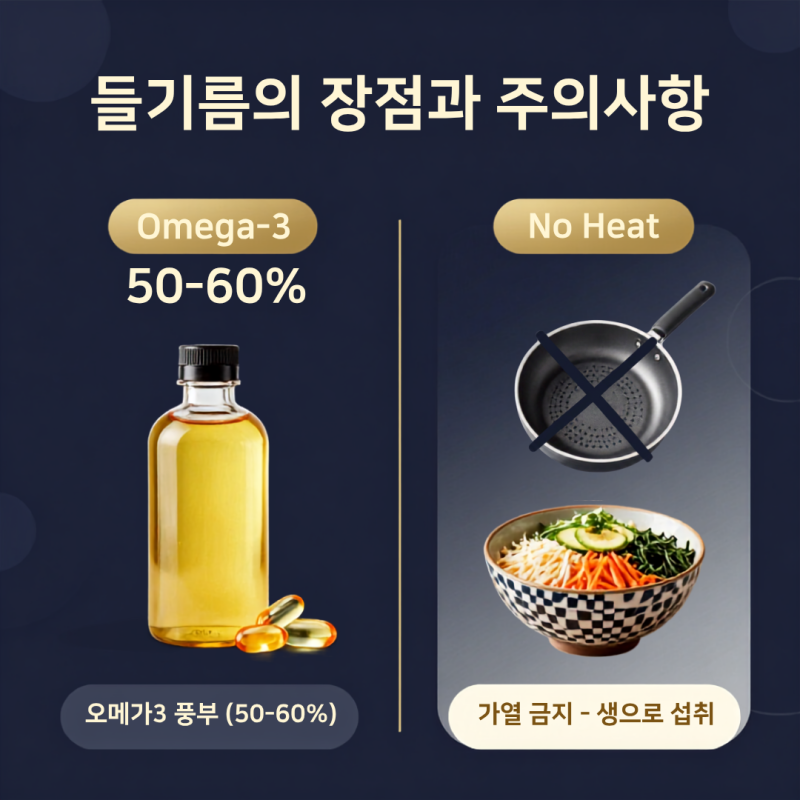
The greatest advantage of perilla oil is its Omega-3 content. Perilla oil is an excellent Omega-3 source, with Omega-3 (alpha-linolenic acid) accounting for 50–60% of its total fatty acids. Including just a little perilla oil in your diet can effectively balance the overall Omega-6 to Omega-3 ratio.
However, there is one important precaution when using perilla oil. Both Omega-3 and Omega-6 are *polyunsaturated fatty acids, which are very vulnerable to heat and oxidize quickly when heated. Therefore, it is best to consume perilla oil raw without heating it. It is ideal as a finishing touch for dishes that have finished cooking, such as seasoned vegetables or bibimbap.
*What are polyunsaturated fatty acids?
They are more vulnerable to oxidation than monounsaturated fatty acids, and their oxidation rate accelerates particularly when heat is applied. Therefore, oils rich in polyunsaturated fatty acids are safer to consume raw or handle at low temperatures rather than using them for high-heat cooking.
Q. Should I buy roasted perilla oil or raw perilla oil?
A. Since Omega-3 is sensitive to heat and can oxidize during the heating process, raw perilla oil is theoretically the safer choice.
While manufacturers of roasted perilla oil often explain that specific processing technologies are applied to inhibit oxidation, clear verification data for this is limited. We recommend choosing raw perilla oil and using it as a final addition to dishes that have already been cooked.
Q. Is it okay to eat sesame oil occasionally?
A. The Omega-6 ratio of sesame oil is quite high, similar to that of corn oil.
However, this doesn’t mean you should exclude sesame oil entirely. If used in small amounts occasionally for flavor, its impact on the overall Omega-6 to Omega-3 balance of your diet is minimal. In fact, simply including perilla oil regularly in your diet is enough to maintain a healthy overall ratio, so you don’t need to worry much about using sesame oil as a seasoning.
Can I fry with olive oil? The role of heating temperature and polyphenols
Whether olive oil can be used for frying is something many people find confusing. In conclusion, it is perfectly fine to use olive oil for frying.
However, frying with extra virgin olive oil is not recommended—not for health reasons, but for economic ones. Because the polyphenols in olive oil defend against many of the harmful substances generated during frying, the food itself actually becomes healthier. The issue is that the presence of polyphenols lowers the smoke point (the temperature at which oil starts to burn), and it is costly to discard expensive oil after just one use.
If you must fry with extra virgin olive oil, it is best to maintain a relatively low temperature between 160 and 180 degrees Celsius. On the other hand, refined olive oil or standard grade olive oil has lower polyphenol content, so its smoke point is similar to other common frying oils, making it perfectly suitable for frying.
Q. Does taking a spoonful of olive oil on an empty stomach every morning really work?
A. Olive oil itself is a healthy oil because it is high in Omega-9 (monounsaturated fatty acids) and has a low Omega-6 ratio.
However, there is no clear evidence yet that consuming it on an empty stomach provides additional special effects. If consuming it on an empty stomach is uncomfortable, you can achieve the same effect simply by using it consistently as your regular cooking oil.
What criteria should be used to choose frying oil?
When choosing an oil for high-heat cooking like frying, it is best to select an oil low in both Omega-3 and Omega-6. This is because both are polyunsaturated fatty acids that oxidize easily at high temperatures.
Based on this criteria, there is an interesting point. While soybean oil has a relatively good Omega-6 to Omega-3 ratio of about 5:1, the very fact that it contains Omega-3 becomes a weakness for high-heat cooking. Canola oil also has an excellent overall fatty acid ratio, but its Omega-3 content is somewhat high, making it less than optimal for frying.
In contrast, oils like olive oil or avocado oil, which are low in both Omega-3 and Omega-6 and high in Omega-9 (monounsaturated fatty acids), are resistant to oxidation and more suitable for high-heat cooking.
How should I change the cooking oil in my home?
Applying what we’ve discussed to daily life, you can establish the following principles:
For regular cooking, it is best to use oils low in Omega-6 and rich in Omega-9, such as olive oil or avocado oil, as your base.
If you find the scent burdensome, you can substitute it with other oils that have a similar fatty acid profile. By adding a little raw perilla oil to supplement Omega-3, you can greatly help bring your Omega-6 to Omega-3 ratio below 4:1, or even close to 1:1. When high-heat cooking like frying is required, choosing an oil low in both Omega-3 and Omega-6, such as refined olive oil or avocado oil, is a way to reduce health risks from oxidation.
Cooking oil is an ingredient that goes into almost every dish every day. Therefore, the choice of oil has a much larger impact on your entire diet than you might think. Rather than a vague perception of ‘oils known to be healthy,’ the habit of judging based on actual fatty acid composition and the Omega-6 to Omega-3 ratio will be of more practical help for long-term health management.
Fields of Practice: Gastrointestinal Diseases, Immune Aging, Functional Medicine, Integrative Medicine, Mind-Body Medicine. Professor Su-yeon Oh (Specialist in Internal Medicine/Gastroenterology) graduated from Seoul National University College of Medicine, completed her residency at Seoul National University Hospital, and is currently a professor at CHA University, practicing at Chaum. She is a life member of the Korean Association of Internal Medicine, the Korean Society of Gastroenterology, and the Korean Society of Gastrointestinal Endoscopy, and has completed an intensive course in Integrative Oncology recognized by the German Medical Association. Furthermore, she strives to implement mind-body healing within the framework of medical practice by incorporating meditation into her treatments. Inquiries: Chaum Immune Enhancement Clinic 02-3015-5300 | 3rd Floor, Chaum, 4-1 Cheongdam-dong, Gangnam-gu, Seoul

Frequently Asked Questions
Is grapeseed oil a healthy cooking oil?
No, it is not, as its omega-6 ratio is excessively high, requiring caution. Grapeseed oil, along with sunflower oil and corn oil, contains over 50% omega-6, which can cause inflammation, while having almost no omega-3, potentially leading to an imbalance in fatty acids in the body.
Why is olive oil good for health?
Yes, olive oil is good for health because it has a low omega-6 ratio and is resistant to oxidation. Olive oil contains only about 10% omega-6, and over 70% omega-9, which does not react well with oxygen, helping to prevent cholesterol oxidation in blood vessels and thus aiding in the prevention of arteriosclerosis.
What is the best way to consume perilla oil?
It is best to consume perilla oil raw, without heating. Perilla oil is rich in omega-3 but is very vulnerable to heat and oxidizes quickly when heated, so it is recommended to add it as a finishing touch to cooked dishes like seasoned vegetables or bibimbap.
Is it okay to use olive oil for deep-frying?
Yes, it is fine to use olive oil for deep-frying. However, extra virgin olive oil has a low smoke point and is expensive, so it's better to use it at low temperatures of 160-180 degrees Celsius, or to use refined olive oil or regular grade olive oil, which have higher smoke points.
Are there any special benefits to consuming olive oil on an empty stomach in the morning?
There is no clear evidence yet that consuming olive oil on an empty stomach provides additional special benefits. Since olive oil itself is a healthy oil, if consuming it on an empty stomach is burdensome, simply using it consistently as a cooking oil in your daily meals can provide sufficient benefits.